On-Post or Off-Post at Fort Bliss: The Break-Even Clock Most PCS Families Never Run
August 13, 2026
August 13, 2026
Most Fort Bliss guides frame the housing decision as rent versus buy. That framing is wrong, or at least incomplete. The real question a PCS family needs to answer is whether their orders will outlast a specific, calculable clock: the number of months it takes an off-post VA purchase to catch up to the walk-away-with-nothing math of living on post. Get that clock wrong and you either lock yourself into a house you sell at a loss when new orders arrive, or you spend two more years paying rent that builds nothing while your neighbor down the street is quietly building equity in the same market.
Nobody hands new arrivals this framework at the Reception Detachment. So here it is.
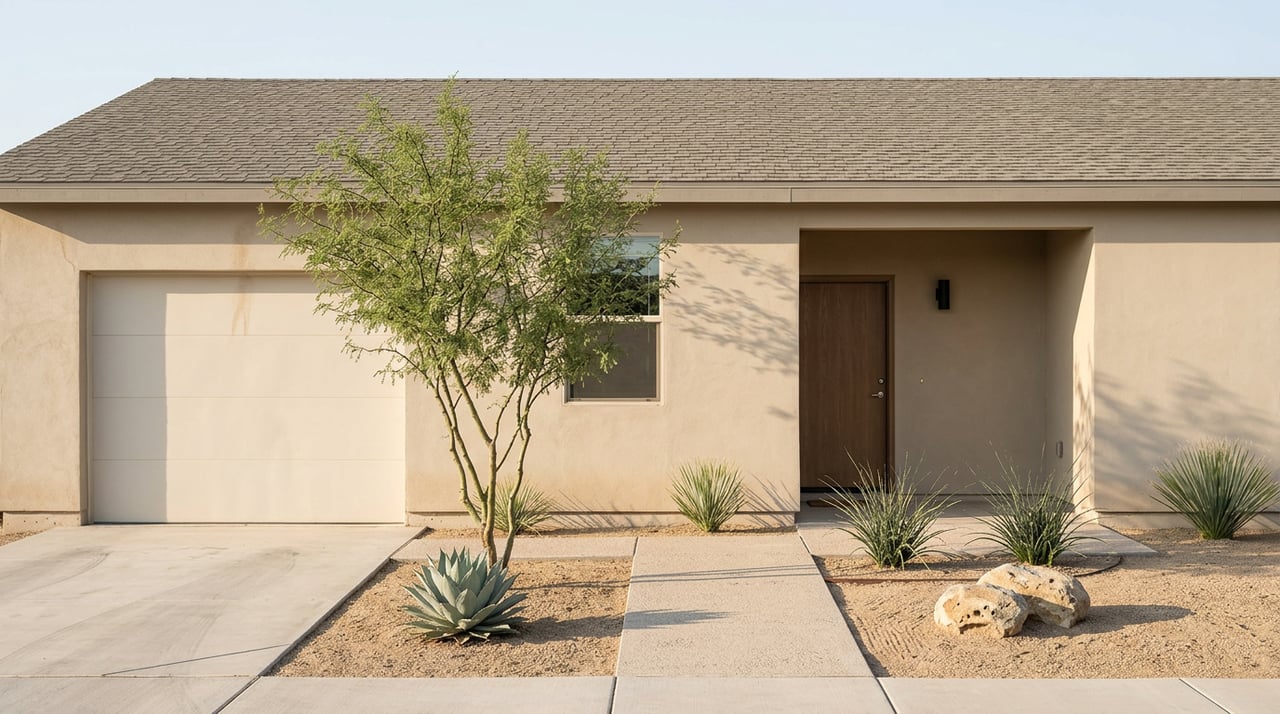
On-post housing at Fort Bliss runs through Balfour Beatty Communities under the Fort Bliss Family Homes program. The deal is straightforward: your Basic Allowance for Housing goes to Balfour Beatty as rent, in full, every month. There is no down payment, no closing costs, no property tax bill, and no maintenance calls you have to make yourself. There is also no equity. When your next set of orders arrives, whatever you paid in over the assignment stays with the housing operator. You leave with a moving truck and nothing else.
That trade makes sense for some families and some assignment lengths. It is a genuinely simple, low-friction option, and for a short unaccompanied tour or a family that wants zero exposure to a local housing market, it is often the right call. The problem is that most families never run the number against the alternative, so they never find out whether they are trading equity for convenience they did not actually need.
Here is where the calculation gets more interesting than the standard guide suggests. The rule of thumb circulating among Fort Bliss-focused lenders puts the equity break-even point for an off-post VA purchase at roughly 24 months, with the math turning meaningfully positive somewhere between 36 and 48 months, especially in the $200,000 to $240,000 price band.
That price band used to describe the middle of the El Paso market. It no longer does. Greater El Paso Association of Realtors data through June 2026 puts the citywide median sale price at $289,000, with homes averaging 68 days on market and sellers netting 99.0 percent of list price. That median has been climbing all year: it sat at $277,950 in May 2026, up 4.9 percent from a year earlier, and it moved through a range of roughly $264,946 to $279,256 across all of 2025.
In plain terms, a family buying at today's citywide median is buying above the price band that produces the fastest break-even. The $200,000 to $240,000 sweet spot still exists in this market, but it is concentrated in specific submarkets rather than sitting at the middle of the citywide number. Northeast El Paso, the area closest to the main gate and to Biggs Army Airfield, is where that entry-level band still lives, with homes there commonly running in the low $200,000s. Buy at the citywide median instead and the clock runs slower than the headline break-even figure implies.
A Fort Bliss buyer with full VA entitlement puts zero down and pays no private mortgage insurance. The first-time-use VA funding fee runs 2.15 percent of the loan amount for a zero-down purchase, which works out to roughly $5,700 on a $265,000 loan. Veterans with a service-connected disability rating of 10 percent or higher are exempt from that fee entirely.
Against a 30-year fixed rate of 6.37 percent, which was the rate reported by Freddie Mac's Primary Mortgage Market Survey for the week of May 7, 2026, the first year or so of payments goes mostly toward interest and the fee gets worked off slowly through principal paydown. That is the arithmetic behind the roughly 24-month break-even window. It does not require the house to appreciate at all. Ordinary principal paydown on a fixed loan gets a buyer to the point where their equity exceeds what they would have spent in fees and closing costs on a comparable off-post purchase. Appreciation, when it happens, just gets a buyer there faster.
The house does not have to go up in value to make the math work. It only has to sit there while you pay it down. Appreciation is the bonus, not the requirement.
That distinction matters for a military family weighing a two-year assignment against a four-year one. If your orders run short, you are relying almost entirely on principal paydown to clear the break-even line before you have to sell. If your orders run longer, the appreciation math in a market that has posted steady, if unspectacular, gains all year starts working in your favor too.
Three things move the break-even date on any individual Fort Bliss purchase more than any generic guide can predict:
A VA appraisal is not a home inspection, and it is worth ordering a separate inspection regardless of loan type. What the VA appraiser checks are Minimum Property Requirements: working heat, a sound roof, safe electrical and plumbing, potable water, and proper sewage disposal. Cosmetic issues, an outdated kitchen, tired carpet, do not fail an MPR review.
The properties that run into trouble tend to be older housing stock, particularly in Central and Downtown El Paso, where deferred maintenance is more common than in newer Northeast or Far East construction. When an MPR issue does surface, the standard fixes are a seller-paid repair before closing, a repair escrow where the lender allows it, or, for a buyer set on an older home with real work to do, a VA Renovation Loan that finances the purchase and the repairs in a single transaction. New construction, built to current code, is essentially built to clear MPRs by definition, which is one reason newer Northeast and Far East subdivisions see so much VA loan volume relative to older neighborhoods closer to downtown.
Fort Bliss straddles the Texas-New Mexico line, and Sunland Park and Anthony, New Mexico sit inside the commute envelope for the main gate, typically 15 to 25 minutes out. The property tax math across that line is not subtle. El Paso County's effective property tax rate runs around 2.45 percent, among the higher rates in Texas. New Mexico's effective rate in the same commute corridor runs roughly 0.6 to 1.0 percent, meaning a New Mexico purchase can carry well under half the annual tax bill of a comparable Texas home.
That tax gap can meaningfully shorten the break-even clock for a family willing to buy across the line. The tradeoff is timeline risk: New Mexico purchases require an NM-licensed appraiser, and that pool is smaller than the Texas side, which typically adds another 5 to 7 days to an already tight VA appraisal window. For a family on a compressed PCS timeline, that delay can matter more than the tax savings.
Does a VA loan cost more upfront than staying on post? Yes, in the sense that a funding fee and closing costs exist and on-post housing has neither. The funding fee is roughly 2.15 percent of the loan for a first-time zero-down VA purchase, waived entirely for buyers with a 10 percent or higher service-connected disability rating.
Can a seller refuse a VA offer? No. A seller cannot decline an offer solely because it uses VA financing, and in a market where VA buyers represent a significant share of transactions, VA offers are routinely accepted without hesitation.
Is the break-even math different for new construction? It can run faster, since new construction is built to clear MPRs without negotiation, which removes one of the timeline risks that slows down appraisals on older homes.
What if my next set of orders arrives before the break-even point? That is the real risk in this decision, and it is exactly why the price band and the appraisal timeline matter as much as the interest rate. A shorter assignment leaves less room for principal paydown to do the work, which is why targeting the lower end of the current price range matters more for a two-year timeline than a four-year one.
If you have orders in hand and want to run this math against your own rank, price range, and timeline before you start touring homes, Derek & DJ can walk through the numbers with you. Call or text us for a free 15-minute market evaluation.
Stay up to date on the latest real estate trends.






Derek & DJ
915-465-2645
[email protected]
[email protected]
Address
471 N Resler Suite B
El Paso TX 79912